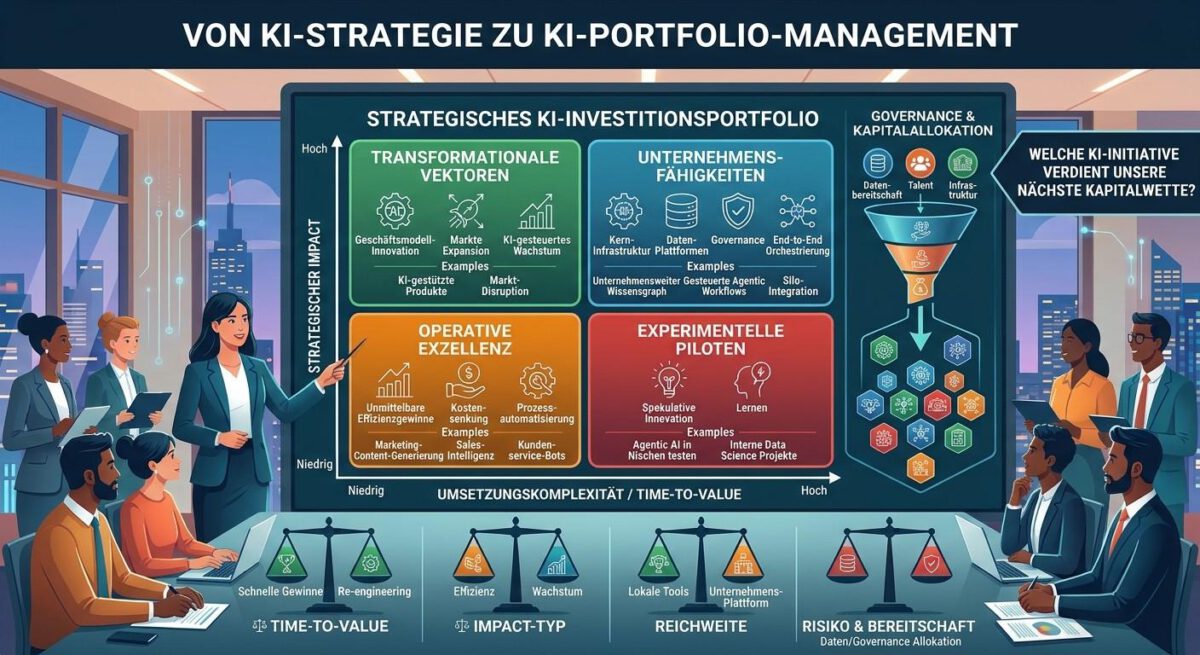
Today, many business leaders are actively discussing their corporate AI strategy. However, the core challenge is not simply formulating a strategy—it lies in intelligently prioritizing distinct AI investments. Organizations frequently operate across multiple value creation logics, distinct risk profiles, and competing investment priorities simultaneously.
There Is No Single „AI World“
AI generates value in fundamentally different ways depending on your underlying business model:
- B2C Enterprises deploy AI primarily to scale reach, personalization, and high-volume transactions.
- B2B Enterprises leverage AI to elevate decision-making, support complex client relationships, and scale account intelligence.
- B2S Enterprises (Service, Consulting, Maintenance, and Managed Services) utilize AI mainly to amplify expert productivity, automate service delivery workflows, and enhance client outcomes.
Because these value creation logics differ fundamentally, a monolithic, enterprise-wide AI strategy cannot effectively serve all business units.
The Greatest Danger Is a Lack of Differentiation
Many corporate leaders pursue a blanket, one-size-fits-all approach:
„We need a single AI strategy for the entire enterprise.“
This thinking frequently leads to misallocated capital. An AI use case that drives high efficiency in marketing may yield negligible value for sales, service, or manufacturing. Furthermore, operational risks, data governance requirements, and investment horizons vary significantly across divisions.
The consequence: Capital and focus are diluted across the board rather than targeted with precision.
AI Drives Value from Three Distinct Sources
The economic benefit of AI stems from three primary value drivers:
Operational Efficiency
- Reduction of effort, overhead, and cycle times
- Automation of repetitive tasks
- Baseline productivity gains
Decision Quality
- Superior forecasting accuracy
- Faster, better-informed strategic decisions
- Reduction of uncertainty, bias, and error rates
Scaling Knowledge and Relationships
- Democratization of expert knowledge
- Hyper-personalization at scale
- Retention and amplification of institutional memory
Not every AI use case contributes equally to all three drivers. Therefore, investments must be evaluated based on their specific value contribution.
From an AI Strategy to an AI Portfolio
The primary leadership objective over the coming years is not to launch as many AI initiatives as possible. Instead, executive teams must build a balanced portfolio:
- Quick Wins vs. Strategic Transformation
- Siloed Business Unit Solutions vs. Enterprise Platforms
- Cost-Efficiency Projects vs. Revenue-Growth Initiatives
- Short-Term ROI vs. Long-Term Moats and Competitive Advantage
Consequently, AI becomes a matter of strategic capital allocation, not merely technological implementation.
AI Is Not a Project — It Is a Continuous Portfolio Process
Because underlying technologies, business models, regulatory landscapes, and market dynamics evolve constantly, an enterprise AI portfolio can never be static. High-performing organizations establish a continuous recalibration process:
- Which use cases are delivering verifiable business value?
- Where are new strategic opportunities emerging?
- Which underperforming initiatives must be deprioritized or terminated?
- Which foundational data and platform capabilities are required next?
The role of executive leadership thus shifts from approving isolated AI projects to continuously governing a dynamic investment portfolio.
Core Executive Takeaway for CEOs and Boards
AI is no longer a technology question. It is a management and capital allocation question.
Enterprises do not need a single, static AI strategy. They require an actively managed AI Portfolio that accounts for the distinct value logics of B2C, B2B, and B2S operations, prioritizes capital based on tangible value creation, and continuously adapts to evolving market conditions.
The essential question for enterprise leadership is therefore not:
„What is our AI strategy?“
Instead, it is:
„How do we allocate our limited capital and talent across the AI portfolio to create the highest sustainable enterprise value?“
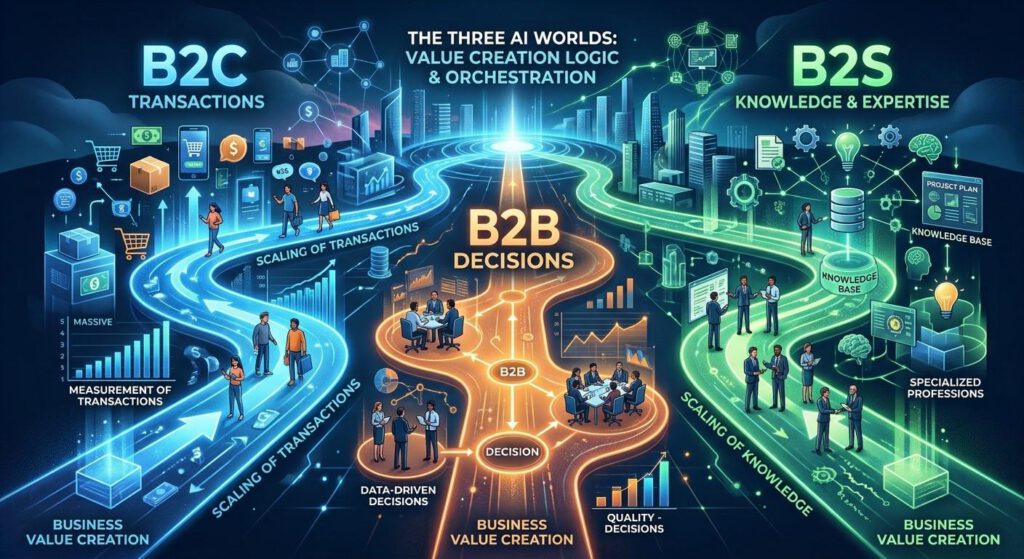
1. The Three AI Realms: B2C, B2B, and B2S
When discussing Artificial Intelligence, it often seems as though there is only a single AI revolution taking place. In reality, the true value of AI depends heavily on a company’s underlying value creation logic.
Most business discussions focus strictly on a simple binary: B2B versus B2C. For an effective AI strategy, however, this framework falls short. Alongside product- and transaction-oriented business models, there is a third logic that is critical for many organizations: the service business.
Accordingly, there are not just two, but three AI realms:
- B2C: Consumer Business
- B2B: Product and Solution Sales to Businesses
- B2S: Knowledge-, Project-, and Service-Based Business
The core insight is simple:
AI does not follow technology. AI follows the value creation logic of your business model.
1. B2C: AI Scales Transactions
In the B2C space, millions of purchasing decisions happen every day. Here, the primary strength of AI lies in optimizing standardized, highly scalable processes.
It enhances areas such as:
- Product recommendations
- Dynamic pricing
- Advertising campaigns
- Customer support
- E-commerce workflows
- Logistics and fulfillment
In this realm, even incremental improvements in conversion rates yield massive financial impact.
- The Core Management Question: How can we use AI to reach, engage, and serve more customers more efficiently?
- Dominant Value Logic: AI scales transactions.
2. B2B: AI Scales Decisions
In B2B environments, the focus shifts away from millions of transactions toward a smaller number of high-stakes, high-value decisions.
Here, AI does not primarily optimize the purchasing checkout process; it optimizes decision-making. It enables organizations to:
- Make institutional knowledge accessible
- Identify buying signals
- Mitigate operational and financial risks
- Uncover account potential
- Scale expert knowledge
- Evaluate strategic decision alternatives
- The Core Management Question: How can we use AI to enable better decision-making?
- Dominant Value Logic: AI scales decisions.
3. B2S: AI Scales Knowledge
In service, consulting, and project-based businesses, the primary product is knowledge.
Consulting firms, law firms, accounting practices, marketing agencies, engineering providers, and IT service companies rely heavily on the productivity and expertise of their talent.
In this realm, AI drives:
- Knowledge management
- Research and synthesis
- Analysis
- Documentation
- Proposal generation
- Project delivery
- Customer success & account management
- The Core Management Question: How can we use AI to expand the reach and impact of our expertise?
- Dominant Value Logic: AI scales knowledge.
Comparative Overview: The Three AI Realms
Dimension | B2C | B2B | B2S |
Primary Goal | Increase transaction volume | Drive better decision-making | Maximize impact of expertise |
Core Resource | Reach & customer access | Customer & account intelligence | Domain expertise & experience |
What AI Scales | Transactions | Decisions | Knowledge & expertise |
Key AI Users | Marketing, Commerce, Customer Support | Marketing, Sales, Customer Success | Subject Matter Experts, Consultants, Service Teams |
Typical Applications | Recommendation engines, Dynamic Pricing, Chatbots | Opportunity intelligence, Account management, Forecasting | Knowledge bases, AI Copilots, Documentation generators |
Key Performance Indicators (KPIs) | Conversion rate, Revenue, Customer Lifetime Value (CLV) | Win rate, Pipeline health, Account growth | Productivity, Utilization rate, Service quality |
Customer Logic | Customer Journey | Account Journey | Service Journey |
Primary Value Lever | Scale & Reach | Decision Quality | Multiplied Expertise |
Divergent Organizational Logics
Many companies operate across multiple realms simultaneously. A manufacturer, for instance, might sell:
- Machinery to enterprises (B2B)
- Spare parts directly online (B2C)
- Maintenance contracts and consulting services (B2S)
Each area operates under a distinct value creation logic, requiring tailored AI tools, data strategies, and priorities.
Therefore, the key executive question is not:
„Which AI technology should we deploy?“
It is:
„Which value creation logic are we trying to optimize?“
These three realms differ not only in customer dynamics, but also in organizational structure:
- In B2C, Marketing typically leads, driving awareness, demand, and transactions.
- In B2B, value is created at the intersection of Marketing, Sales, and Customer Success. Marketing generates demand, Sales navigates complex buying decisions, and Customer Success nurtures long-term accounts.
- In B2S, experts and service delivery teams are the core product. The greatest AI leverage comes from scaling their collective knowledge and experience.
The Common Future: Systemic Orchestration
Despite these differences, all three realms are moving toward a shared future.
AI is shifting from automating isolated tasks to orchestrating entire end-to-end systems:
- In B2C: Orchestrating customers, content, offers, and transactions.
- In B2B: Orchestrating data, buying centers, decisions, and enterprise accounts.
- In B2S: Orchestrating knowledge, experts, workflows, and service delivery.
The future does not belong to the companies with the highest level of automation. It belongs to the companies with the best overall orchestration.
Executive Takeaways
Many leaders attempt to build a single, blanket AI strategy. That is precisely where the strategic error lies.
A single organization can operate across B2B, B2C, and B2S business models at the same time—pursuing three fundamentally different value creation logics. Consequently, the required data, processes, capabilities, and AI use cases will differ significantly.
- If you ignore these differences, you will treat AI merely as a technology tool.
- If you understand them, you will use AI as a strategic lever to maximize value creation.
The essential leadership challenge in the AI era is not simply implementing AI—it is applying the right AI to the right value creation logic:
- B2C scales transactions.
- B2B scales decisions.
- B2S scales expertise.
Managing all three areas under a uniform AI strategy inevitably leads to misaligned priorities and misallocated resources. The primary leadership task is not model selection or tool procurement; it is understanding your value creation engine and prioritizing investments accordingly.
Companies will not fail because they used too little AI. They will fail because they prioritized the wrong AI investments.
- In the past, executives asked: „What IT infrastructure do we need?“
- Today, executives must ask: „Which value driver do we want to multiply with AI?“
Without a clear answer to this question, you build a technology stack. With a clear answer, you build a sustainable competitive advantage.
The winner will not be the company with the best AI—it will be the company with the best allocation of AI.
2. Why a Single AI Strategy Fails: The Risk of One-Size-Fits-All Thinking
As established, AI creates value differently depending on your core business model:
- B2C scales transactions.
- B2B improves decision-making.
- B2S (Services/Knowledge) multiplies expertise.
When value creation logic varies across different parts of an organization, the exposure to risk varies just as significantly. Yet, many companies attempt to execute a single, blanket AI strategy across their entire enterprise. This lack of differentiation—rather than flawed technology—represents one of the greatest threats to successful AI transformation.
The One-Size-Fits-All Misconception
Most AI initiatives start with technical questions:
- Which foundation model should we use?
- Which platform or enterprise framework?
- Which AI agents and automation tools should we deploy?
The more critical executive questions are:
„What value are we trying to create, and what specific risks are we trying to mitigate?“
Different business units demand distinct priorities, governance structures, and key performance indicators (KPIs). Organizations that ignore these nuances end up optimizing for technology instead of business outcomes.
Three Realms, Three Risk Profiles

1. B2C: AI Scales Errors
In consumer-facing operations, AI’s primary strength lies in massive scalability. However, that scale is also its greatest liability. Faulty product recommendations, automated pricing errors, or flawed personalization algorithms do not happen in isolation—they execute millions of times in seconds.
- The Core Risk: AI doesn’t just scale success; it scales mistakes.
- Strategic Focus: Robust governance, real-time quality assurance, data privacy, and brand equity protection must take center stage.
2. B2B: AI Creates the Illusion of Precision
In high-stakes B2B environments, decisions occur less frequently, but each carries substantial economic impact. Flawed account prioritization, inaccurate market intelligence, or biased investment models can result in significant financial loss.
- The Core Risk: The more convincing AI outputs appear, the greater the temptation to accept them without validation.
- Strategic Focus: The threat is not the volume of errors, but their magnitude and strategic impact. Human-in-the-loop oversight is essential.
3. B2S: AI Threatens Differentiation
In professional services, consulting, and knowledge-based work, AI dramatically boosts expert productivity and speeds up deliverable generation. However, if every competitor relies on the exact same underlying models, services risk becoming commoditized, margins shrink, and perceived expertise diminishes.
- The Core Risk: AI doesn’t just scale knowledge; it can also scale mediocrity.
- Strategic Focus: The key lies in combining AI capabilities with proprietary human experience, creativity, domain expertise, and strategic judgment.
The Common Pitfall: Misaligned Metrics
Many AI implementations fail not because of technological limitations, but because of poor governance and inappropriate performance metrics. KPIs must directly reflect each unit’s underlying value logic:
- B2C Metrics: Conversion rate, revenue growth, Customer Lifetime Value (CLV).
- B2B Metrics: Win rate, pipeline health, account expansion, customer retention.
- B2S Metrics: Client outcomes, billable utilization, knowledge productivity, service quality.
Applying a uniform set of KPIs across all business units inevitably incentivizes the wrong behaviors.
Strategic Framework: Value vs. Risk
AI should not be managed as a uniform technology stack, but as a balanced portfolio of distinct value creation and risk profiles:
Realm | Value Driver | Primary Risk Profile |
B2C | Scaling transactions | Scaling systemic errors |
B2B | Improving strategic decision quality | Strategic miscalculations / Illusion of certainty |
B2S | Scaling domain expertise | Loss of differentiation & commoditization |
The essential executive question is not: „Which AI should we deploy?“ It is: „Where are the specific risks and opportunities located across our different business models?“
Executive Takeaways
The first phase of AI transformation was technology-driven. The next phase will be defined by risk management and portfolio allocation.
Forward-thinking leadership teams will move past asking where AI can be applied. Instead, they will ask:
- Where does AI deliver the highest strategic leverage?
- Where does it introduce the most critical vulnerabilities?
- What priorities and safeguards must we establish across our distinct value models?
The market leaders of tomorrow will not be the companies with the most AI deployments, but those that best manage and mitigate AI-related risks.
3. The Three Sources of AI Value
Having examined the different AI realms and their associated risk profiles, a critical question emerges: Where does the actual economic value of AI come from?
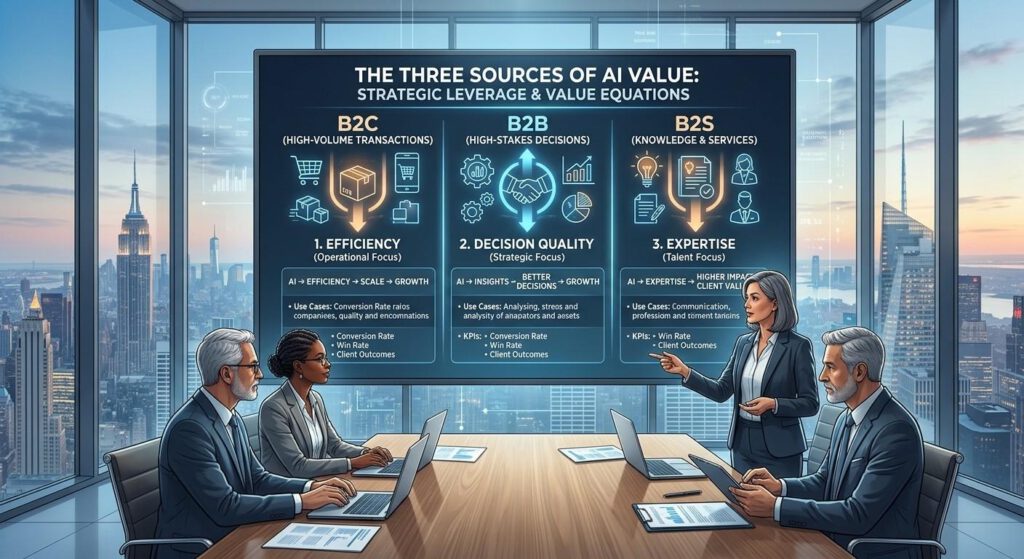
Many organizations primarily associate AI with productivity, automation, and cost reduction. However, productivity is only one of three distinct sources of AI value. Depending on the underlying business model, value is generated in fundamentally different ways. The core management task is to identify which value driver is essential for your specific enterprise.
The Three Sources of AI Value
1. Efficiency
In B2C operations, value is generated primarily by optimizing highly scalable processes. AI enhances product recommendations, dynamic pricing, customer support, and logistics. Even incremental improvements can yield massive economic impacts when applied to high-volume transactions.
Value Equation: AI → Efficiency → Scale → Growth
2. Decision Quality
In B2B environments, the greatest leverage often lies not in raw automation, but in better decision-making. AI supports market analysis, forecasting, account prioritization, and risk assessment. Value is created through sharper focus, better priorities, and more effective resource allocation.
Value Equation: AI → Insights → Better Decisions → Account Growth
3. Expertise
In service-, consulting-, and knowledge-based businesses, value creation is rooted in domain expertise, experience, and problem-solving capabilities. AI assists experts with research, synthesis, documentation, and solution development, multiplying their operational impact.
Value Equation: AI → Expertise → Higher Impact → Customer Value
Comparative Executive Overview: The Three Sources of AI Value
Dimension | B2C | B2B | B2S |
Dominant Value Source | Efficiency | Decision Quality | Expertise |
How AI Creates Value | Automation & Scaling | Better Prioritization & Decisions | Multiplication of Knowledge & Experience |
Core Management Question | How do we drive more transactions with the same resources? | How do we make better strategic decisions? | How do we multiply the impact of our experts? |
Typical AI Use Cases | Personalization, Dynamic Pricing, E-Commerce, Service Automation | Forecasting, Account Intelligence, Opportunity Management, Scenario Planning | Knowledge Management, Copilots, Advanced Analytics, Project & Service Support |
Key Performance Indicators (KPIs) | Conversion Rate, Revenue, Customer Lifetime Value (CLV) | Win Rate, Account Growth, Client Retention, Share of Wallet | Service Quality, Knowledge Productivity, Client Success |
Primary Value Lever | Scale | Decision Quality | Impact of Expertise |
Primary Risk Profile | Scaling Systemic Errors | Strategic Miscalculations | Loss of Differentiation |
Dominant Value Equation | AI → Efficiency → Scale → Growth | AI → Insights → Decisions → Growth | AI → Expertise → Impact → Value |
Management Priority | Automate | Prioritize | Empower |
Executive Quick Assessment
- If your business primarily thrives on high-volume transactions → Maximize Efficiency
- If your business relies on high-stakes, high-value decisions → Improve Decision Quality
- If your business is driven by expert knowledge and professional services → Scale Expertise
From Automation Thinking to Value Creation Thinking
Many organizations kick off their AI initiatives with technology-first questions:
- Which platform should we adopt?
- Which foundation models should we deploy?
- Which processes can we automate?
While these technical considerations matter, they miss the bigger picture. The strategically vital executive question is: What form of value are we trying to generate?
A retail enterprise will set completely different priorities than an industrial manufacturer. In turn, a manufacturer operates under a different logic than a consulting firm or service provider. Deploying the exact same technology does not automatically yield the same economic outcome.
Core Executive Takeaway
Companies rarely fail because they adopt too little AI. They fail because they optimize for the wrong form of value.
The next phase of AI transformation will not be technology-driven; it will be value-driven:
- In B2C, AI drives efficiency.
- In B2B, AI enhances decision-making.
- In B2S, AI multiplies expertise.
The underlying technology stack may be identical, but the economic value is unlocked in entirely different ways across each business model.
The winning enterprises of tomorrow will not be those with the most AI tools, but those that precisely understand which source of AI value truly drives their business model.
This naturally leads to the next operational challenge: Many enterprises combine multiple business models simultaneously. They must not only understand distinct value sources, but also manage multiple AI logics in parallel—marking the transition toward governing a comprehensive enterprise AI portfolio.
4. From AI Strategy to AI Portfolio
After examining the different AI realms, their risk profiles, and their sources of value creation, an uncomfortable truth becomes apparent:
Most enterprises do not operate a single business model. They operate a portfolio of distinct business models.
This is precisely why the concept of a single, blanket AI strategy fails.
While many organizations are still searching for the ultimate master plan for their AI transformation, reality has already moved on. Products, services, digital channels, subscriptions, and data-driven offerings increasingly exist side-by-side. Each of these value creation logics generates different opportunities, distinct risks, and unique requirements for deploying AI.
Consequently, the decisive leadership challenge is no longer:
How do we develop an AI strategy?
Instead, it is:
How do we govern multiple AI strategies simultaneously?
The Reality of Modern Enterprises
Take a typical mid-sized industrial manufacturer. At first glance, the company sells heavy machinery. Upon closer inspection, however, a much more complex picture emerges:
- The core business sells capital goods to enterprises (B2B).
- The spare parts business sells standardized products via digital channels (B2C logic).
- The service division sells maintenance, training, and ongoing support (B2S).
- Digital platforms supply customer data and generate recurring revenue streams.
- Remote services and AI-powered assistance systems create entirely new service offerings.
Formally, it is a single company. Strategically, however, it operates multiple distinct value creation models under one roof.
This diversity existed long before AI. But with AI, it becomes immediately visible and critical to management.
Why a Single Governance Logic Is Not Enough
Many companies evaluate all AI initiatives using the exact same metrics:
- Productivity gains
- Automation levels
- Cost reduction
- Number of active use cases
These metrics are easy to track. However, they are frequently misaligned because the underlying objectives differ fundamentally:
- In e-commerce, AI should optimize transactions.
- In sales, AI should enable better decision-making.
- In service delivery, AI should multiply the impact of experts.
Therefore, the exact same investment can produce completely divergent outcomes across different operational areas.
The question is no longer:
Does the AI work?
Instead, it is:
For which value creation logic does it work?
From Functions to Value Creation Logics
Today, many AI initiatives are planned along traditional organizational silos:
- Marketing
- Sales
- Service
- Operations
- HR
- Finance
This functional approach is increasingly falling short. The true dividing line runs not between departments, but between value creation logics.
A single sales organization may simultaneously:
- Drive B2B solution selling,
- Sell digital self-service offerings, and
- Renew long-term service contracts.
Even though the same organizational unit is involved, the requirements for AI differ significantly.
Therefore, AI should not be governed through a functional lens, but through a value-driven lens. The central question is: Where is value created, and what form of AI best supports that specific value creation?
The AI Portfolio Model

From a management perspective, this creates a new core responsibility: Enterprise leaders must govern their AI initiatives like an investment portfolio.
Similar to managing products, client segments, or capital investments, leadership must balance conflicting objectives, risks, and performance metrics:
- Value Portfolio: Increasing efficiency vs. improving decision-making vs. scaling expertise.
- Risk Portfolio: Mitigating systemic errors vs. preventing strategic miscalculations vs. protecting brand trust and quality.
- Innovation Portfolio: Optimizing existing workflows vs. incubating new business models vs. deploying autonomous agentic systems.
The executive mandate is to continuously balance and recalibrate this portfolio.
The New Role of Leadership
- In the first phase of digitization, leaders had to understand digital technologies.
- In the first phase of the AI revolution, they had to identify AI use cases.
- In the next phase, they must orchestrate multiple AI logics.
They no longer simply decide:
- which projects are implemented,
- which budgets are allocated, or
- which systems are deployed.
Instead, they must determine:
- what form of value should be created,
- what risks are acceptable,
- which business units receive priority, and
- how disparate AI systems interact.
The leadership mandate thus shifts from isolated technology decisions to comprehensive portfolio orchestration.
The Competitive Advantage of Tomorrow
- Many enterprises will deploy the exact same foundation models.
- Many will utilize the same enterprise platforms.
- Many will access the same agent frameworks.
Technology alone is increasingly losing its power as a differentiator.
Sustainable competitive advantage stems from something entirely different: The ability to govern and orchestrate multiple AI logics simultaneously.
The most successful companies will not be those that deploy the most AI. They will be those that best interconnect their diverse value creation logics. They understand where AI drives efficiency, where it improves decision-making, and where it multiplies expertise—weaving all three dimensions into a cohesive whole.
The New Management Reality
The notion of a single, uniform AI strategy belongs to a bygone era of management.
What organizations need moving forward is not a monolithic AI plan. They require an AI portfolio:
- A portfolio of distinct value sources,
- A portfolio of tailored risk profiles, and
- A portfolio of diverse agents, data assets, and decision-making mechanisms.
The defining executive question is therefore no longer:
Do we have an AI strategy?
Instead, it is:
Is our AI portfolio aligned with the distinct value creation logics of our enterprise?
Management Checklist: Is Your Enterprise Operating in AI Portfolio Mode?
Use this self-assessment to evaluate whether AI is still treated merely as a tactical technology project or governed as a strategic portfolio.
Scoring Scale
Points | Meaning |
0 | Does not apply |
1 | Applies partially |
2 | Applies mostly |
3 | Applies fully |
1. Do We Understand Our Value Creation Logics?
Score | Statement |
☐ 0 ☐ 1 ☐ 2 ☐ 3 | We clearly understand which parts of our business follow B2C, B2B, or B2S logics. |
☐ 0 ☐ 1 ☐ 2 ☐ 3 | We have identified the dominant value driver for each business unit. |
☐ 0 ☐ 1 ☐ 2 ☐ 3 | Our AI priorities are aligned with business models rather than technology stacks. |
Max: 9 Points
2. Are We Optimizing the Right Value Source?
Score | Statement |
☐ 0 ☐ 1 ☐ 2 ☐ 3 | Our AI initiatives are explicitly mapped to a specific value source. |
☐ 0 ☐ 1 ☐ 2 ☐ 3 | We clearly differentiate between efficiency, decision-quality, and expertise initiatives. |
☐ 0 ☐ 1 ☐ 2 ☐ 3 | We do not measure success solely through raw productivity gains. |
Max: 9 Points
3. Do We Govern Risks Differentially?
Score | Statement |
☐ 0 ☐ 1 ☐ 2 ☐ 3 | The specific AI risks for each business segment are explicitly understood. |
☐ 0 ☐ 1 ☐ 2 ☐ 3 | Critical high-stakes decisions are safeguarded via human-in-the-loop governance. |
☐ 0 ☐ 1 ☐ 2 ☐ 3 | Governance policies, accountability frameworks, and escalation pathways are defined. |
Max: 9 Points
4. Do We Manage AI as a Portfolio?
Score | Statement |
☐ 0 ☐ 1 ☐ 2 ☐ 3 | AI is managed as a portfolio rather than a collection of isolated projects. |
☐ 0 ☐ 1 ☐ 2 ☐ 3 | Active prioritization occurs between quick wins, strategic initiatives, and transformation. |
☐ 0 ☐ 1 ☐ 2 ☐ 3 | Projects can be systematically deprioritized or halted based on performance. |
Max: 9 Points
5. Are We Using the Right Metrics?
Score | Statement |
☐ 0 ☐ 1 ☐ 2 ☐ 3 | Different value logics are governed using tailored KPIs. |
☐ 0 ☐ 1 ☐ 2 ☐ 3 | Business value takes precedence over activity metrics (e.g., number of prompts/users). |
☐ 0 ☐ 1 ☐ 2 ☐ 3 | AI investments are evaluated based on tangible economic contribution. |
Max: 9 Points
6. Do We Have True Portfolio Orchestration?
Score | Statement |
☐ 0 ☐ 1 ☐ 2 ☐ 3 | There is a central steering function overseeing the enterprise AI portfolio. |
☐ 0 ☐ 1 ☐ 2 ☐ 3 | The portfolio is regularly reviewed and recalibrated. |
☐ 0 ☐ 1 ☐ 2 ☐ 3 | Data, processes, platforms, and agent frameworks are coordinated cross-functionally. |
Max: 9 Points
Executive Scorecard
0–18 Points | AI Project Mode
- Isolated use cases dominate; focus on tools over business value; high risk of siloed solutions.
- Management Mandate: Establish foundational governance and cross-functional prioritization.
19–36 Points | AI Strategy Mode
- Initial strategic roadmaps exist; AI is viewed across departments, but value sources are not yet consistently differentiated.
- Management Mandate: Transition toward formal portfolio governance.
37–48 Points | AI Portfolio Mode
- AI is actively prioritized; distinct value sources and risk profiles are accounted for; resources are allocated with precision.
- Management Mandate: Scale enterprise orchestration and cross-functional synergy.
49–54 Points | AI Portfolio Excellence
- AI is deeply embedded in core corporate governance; value sources, risks, and investments are continuously recalibrated; AI serves as a strategic competitive advantage.
- Management Mandate: Scale agentic business models and autonomous value creation systems.
Concluding CEO Question
Imagine you could invest an additional €1 million (or $1 million) in AI tomorrow morning.
Do you know precisely:
- into which business unit,
- to strengthen which source of value,
- to mitigate which specific risk, and
- with what expected economic return?
If you cannot answer these questions unequivocally, you likely do not lack a better AI strategy. You lack an AI portfolio.
The core insight of this chapter is clear: Enterprises do not need a single AI strategy. They need an AI portfolio.
However, this introduces the next operational challenge: A portfolio cannot simply be defined once and forgotten. Markets shift, technologies evolve, new risks emerge, and priorities change.
Therefore, AI is neither a static project nor a fixed master plan. AI is an enterprise portfolio that must be continuously recalibrated.
That is precisely what the next chapter addresses.
5. AI Is Not a Project — It Is a Portfolio
Many enterprises kick off their AI journeys with isolated use cases:
- Marketing wants a content creation agent.
- Sales demands account intelligence.
- Customer service requires knowledge assistants.
- Production plans predictive maintenance.
While each of these initiatives may make sense individually, the real challenge lies elsewhere: AI creates internal competition for resources, data, technical capabilities, and capital allocation.
Therefore, AI is not just a project. AI is an enterprise portfolio.
The Core Dilemma
Most organizations focus their discussions on visible applications such as copilots, chatbots, or autonomous agents. However, long-term success depends on foundational enablers:
- Data infrastructure
- Institutional knowledge
- Enterprise platforms
- Governance frameworks
- Security protocols
- Talent capabilities
Organizations that prioritize applications alone may capture short-term wins, but they ultimately build new operational silos and structural complexity.
The Four Pillars of AI Portfolio Management
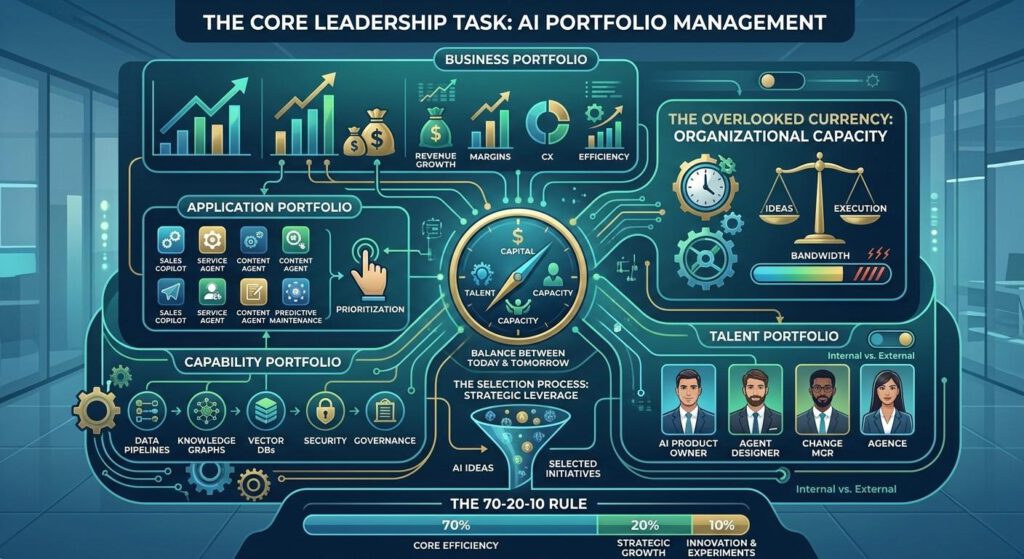
To govern AI effectively, leadership must balance four interconnected portfolios:
1. The Business Portfolio
This defines where AI is expected to create the greatest economic value:
- Revenue growth
- Customer retention & lifetime value
- Margin expansion
- Service quality
- Risk mitigation
Management Question: Where does AI generate the highest strategic leverage?
2. The AI Use Case Portfolio
Only after defining business value should specific applications be prioritized:
- Sales Copilots
- Customer Service Agents
- Enterprise Knowledge Assistants
- Document Automation Pipelines
- Marketing Generation Agents
Management Question: Which applications most strongly support our corporate strategy?
3. The Capability Portfolio
Every successful AI initiative relies on shared foundational capabilities:
- Unified data platforms
- Enterprise knowledge graphs
- Agent orchestration frameworks
- Rigorous governance and compliance
- Role-based access control models
While these capabilities do not generate immediate visible business value, they are prerequisites for scaling.
4. The Talent Portfolio
The primary bottleneck in AI transformation is rarely technology—it is people. Essential roles include:
- AI Product Owners
- Data Engineering Experts
- Agent Designers
- Governance and Compliance Officers
- Change Management Leaders
Management Question: Which capabilities do we build internally versus source externally?
The Overlooked Currency: Organizational Capacity
Executive teams often view AI primarily as a financial exercise:
- What are the software licensing costs?
- What is the projected ROI?
- What is the payback period?
While necessary, these metrics miss the ultimate constraint.
As AI initiatives mature, the true bottleneck is almost never capital—it is execution capacity.
A successful AI initiative requires cross-functional human effort to:
- Clean, structure, and govern data
- Re-engineer core operational processes
- Provide domain expertise
- Validate system outputs
- Integrate enterprise architectures
- Enable and train end-users
- Drive organizational change
Because these key individuals are finite resources, every new AI project directly competes for bandwidth across Business Units, IT, Data Teams, Executive Leadership, and Change Management.
AI programs rarely fail from a lack of capital; they fail from organizational exhaustion.
AI Portfolio Management must balance Capacity Planning alongside Financial Planning. Every proposed initiative must transparently quantify:
- Expected Business Impact
- Capital Budget
- Person-Days / FTE Allocations
- Business-Side Commitment
- Integration & Data Overhead
- Enablement & Training Effort
- Ongoing Operational Maintenance
The defining leadership question shifts from:
„Can we afford this AI project?“
To:
„Do we have the organizational bandwidth to actually capture its value?“
Why Quick Wins Are Essential
Focusing exclusively on long-term transformation poses severe risks. Without visible progress, organizational fatigue sets in, user adoption stalls, and executive support wavers.
Every balanced AI portfolio requires early, visible victories—such as:
- Automated meeting summaries
- Enterprise knowledge search
- Intelligent document extraction
- RFx & proposal support
- Frontline service copilots
While these quick wins rarely reinvent a business model, they serve three critical functions:
- Building Organizational Buy-In & Momentum
- Accelerating Institutional Learning
- Generating Short-Term Value to Fund Long-Term Innovation
Quick wins are not the final destination of an AI transformation; they are the fuel that powers it.
Balancing Today and Tomorrow: The 70-20-10 Rule
A healthy AI portfolio deliberately balances multiple time horizons:
- 70%: Core Efficiency & Proven Productivity Use Cases
- 20%: Strategic Growth & Competitive Differentiation
- 10%: High-Upside Experiments & Agentic Innovations
This resource allocation model must govern capital investment, talent allocation, and organizational capacity simultaneously.
Governance: Who Owns the Portfolio?
AI accountability cannot reside solely within the IT department.
While IT owns platform engineering, security, and technical governance, it does not own enterprise value creation—that accountability belongs to executive leadership.
Organizations require a clear governing body for AI Portfolio Management, such as:
- The C-Suite / Executive Committee
- An Enterprise AI Steering Committee
- An AI Portfolio Board
- A Chief AI Officer (CAIO)
Their mandate is to establish strategic priorities, resolve resource conflicts, coordinate capital investments, allocate talent and execution capacity, build shared capabilities, and capture cross-functional synergies.
The New Executive Imperative
Most enterprise AI initiatives fail not because the underlying models fall short, but because leadership fails to synchronize business value, use cases, capabilities, talent, capacity, and priorities.
This gap demands a new management discipline: AI Portfolio Management.
It fuses the rigor of traditional IT portfolio management with the dynamic demands of the AI era. It requires governing technologies alongside:
- Business Value Drivers
- Application Architectures
- Shared Platform Capabilities
- Talent & Skill Sets
- Capital Allocation
- Organizational Bandwidth
Moving forward, the defining leadership challenge will not be:
“Which AI tools should we adopt?”
It will be:
“Which combination of applications, capabilities, talent, capacity, and investments provides the strongest strategic advantage for our enterprise?”
Organizations that address this systematically will move beyond viewing AI as a series of disconnected IT projects. They will treat AI as what it truly is: a dynamic, high-leverage portfolio that must be continuously calibrated to win.
Dr. Klaus Heinzelbecker on LinkedIn