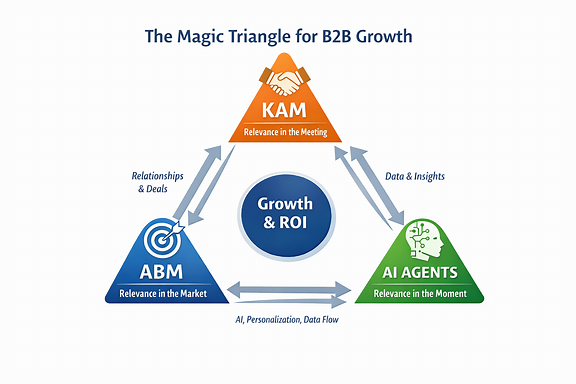
Many companies invest in Account‑Based Marketing (ABM), but very few unlock its full potential. The reason is simple: ABM without Strategic Account Management (SAM/KAM) becomes a marketing firework — visible, but not powerful enough to move revenue.
A new evolution is now emerging: AI Agents that don’t replace teams — they connect them.
For the first time, they create an operational bridge between Marketing, Sales, and Account Management. The result is a system that doesn’t just run campaigns — it scales relationships, orchestrates buying groups, and accelerates revenue.
This paper outlines:
- why Account Management is the missing piece in most ABM programs
- how AI Agents unify data, context, and execution
- how the three functions together create a learning, adaptive GTM system
- what technical and organizational foundations are required
- how mid‑market companies can implement this model without additional headcount
This is not a theoretical framework. It’s a practical operating model for companies that want to build a scalable, AI‑enabled revenue engine.
Why Account Management Is the Missing Link — and How AI Agents Amplify It
Many ABM programs fail for one reason: Marketing sees signals. Account Management sees reality.
Marketing works with scalable indicators:
- clicks
- downloads
- intent signals
- engagement scores
These signals are valuable — but they remain surface‑level.
Account Managers, on the other hand, understand what’s actually happening inside the account:
- political dynamics
- internal power centers
- hidden blockers
- personal motivations
- budget cycles and decision logic
These insights are not scalable — but they are decisive.
AI Agents bridge both worlds by:
- connecting marketing signals with account‑level context
- identifying patterns humans overlook
- modeling stakeholder dynamics
- surfacing risks and opportunities early
The result is a 360° view that neither Marketing nor Sales can create alone.
From Leads to Champions
ABM opens doors — but open doors don’t close deals.
- ABM creates awareness and relevance.
- Account Management builds trust, relationships, and internal alliances.
- AI Agents orchestrate touchpoints and prioritize stakeholders.
An AI Agent can:
- detect which stakeholder is active
- recommend the right content
- suggest the next best action
- flag risks inside the buying group
- strengthen internal champions
This creates a continuous, intelligent relationship flow — one that doesn’t depend on individual team members.
Closing the Feedback Loop
In many organizations, the feedback loop between Marketing and Sales is broken.
- Marketing doesn’t know what happens in meetings.
- Sales doesn’t know which content performs.
- Both optimize in the dark.
Account Management provides the reality check. AI Agents make that reality check scalable.
They can:
- feed KAM insights back into Marketing in real time
- adapt content automatically
- optimize campaigns dynamically
- evaluate messaging tone and impact
- analyze buying‑group reactions
ABM becomes more targeted — and more alive.
How AI Agents Connect ABM and Account Management Across the Customer Journey
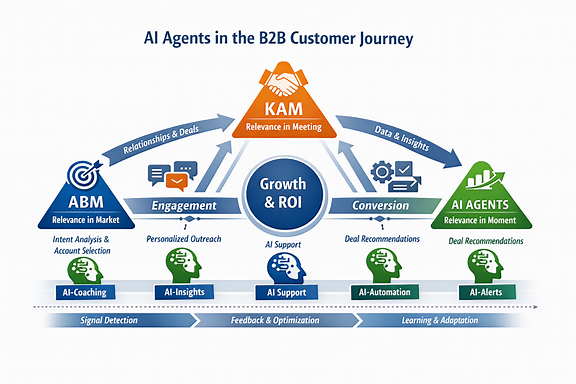
The real power of AI Agents doesn’t come from isolated tasks — it emerges when they operate across the entire customer journey. They create a continuous corridor of data, context, and recommended actions between Marketing, Sales, and Account Management. Exactly in the places where today’s GTM systems still suffer from silos, blind spots, and broken handoffs.
Below are the key leverage points across the journey.
- Awareness: Precise Targeting & Intent Radar
ABM Contribution: Marketing identifies target accounts, analyzes intent signals, and delivers personalized content.
Account Management Contribution: Account Managers add context:
- Which accounts are strategic?
- Where do relationships already exist?
- Which topics are politically sensitive?
AI Agent Contribution: AI Agents:
- analyze intent signals across all sources
- detect patterns that indicate early buying readiness
- prioritize accounts based on relevance, potential, and relationship history
- recommend themes that resonate with the buying group
Result: A precise, dynamic targeting process that is not only data‑driven — but relationship‑intelligent.
- Consideration: Relevant Content & Buying Group Mapping
ABM Contribution: Personalized content, campaigns, and touchpoints.
Account Management Contribution: Insights into stakeholders, internal dynamics, and decision logic.
AI Agent Contribution: AI Agents:
- build a dynamic buying‑group model
- detect new stakeholders the moment they become active
- recommend content tailored to each role and situation
- identify blockers and potential champions
- analyze tone and reactions to messaging
Result: A constantly updated buying‑group radar that guides both Marketing and Sales with precision.
- Evaluation: Orchestrated Touchpoints & Relationship Intelligence
ABM Contribution: Nurturing, personalized sequences, thought leadership.
Account Management Contribution: Relationship building, meetings, workshops, political navigation.
AI Agent Contribution: AI Agents:
- orchestrate touchpoints across all channels
- recommend the next best action
- detect when a stakeholder disengages or hesitates
- analyze meeting notes and extract risks
- synchronize ABM and Account Management activities in real time
Result: A consistent, intelligent dialogue with the account — without duplication, gaps, or conflicting messages.
- Decision: Deal Acceleration & Risk Management
ABM Contribution: Case studies, proof points, executive messaging.
Account Management Contribution: Negotiation, internal alignment, decision leadership.
AI Agent Contribution: AI Agents:
- identify decision barriers early
- simulate scenarios (“If stakeholder X blocks, then…”)
- recommend argumentation lines based on prior interactions
- prioritize the most influential champions for the final phase
- deliver real‑time alerts when sentiment shifts inside the buying group
Result: Fewer surprises, fewer friction points, faster decisions.
- Post‑Sale: Adoption, Expansion & Loyalty
ABM Contribution: Customer marketing, success stories, upsell campaigns.
Account Management Contribution: Account development, governance, long‑term relationships.
AI Agent Contribution: AI Agents:
- detect usage and adoption patterns
- identify expansion opportunities
- recommend relevant success content
- analyze support tickets and sentiment data
- flag early churn risks
Result: A continuous, data‑driven account‑growth process that makes revenue expansion predictable.
The Combined Effect: A Learning System Instead of Isolated Activities
When AI Agents operate across the customer journey, a new GTM operating model emerges:
- ABM delivers signals.
- Account Management provides context.
- AI Agents turn both into actionable recommendations.
The result is a system that learns, anticipates, and orchestrates — creating the foundation for scalable B2B growth.
The Technical Foundations for the Growth Triangle (ABM + Account Management + AI Agents)
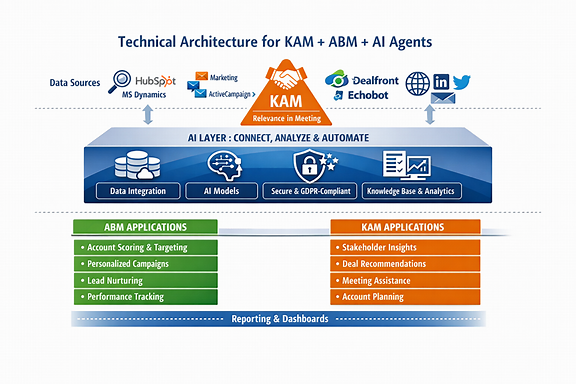
For ABM, Account Management, and AI Agents to operate not as parallel tracks but as an integrated growth engine, companies need a clear technical foundation. Most organizations don’t fail because of strategy — they fail because of fragmented systems, inconsistent data, and unclear ownership.
Here’s the technical infrastructure required to make the model work.
- An Integrated Data Architecture (A Single Source of Truth)
For AI Agents to detect patterns and orchestrate ABM and Account Management effectively, data must flow across systems:
- CRM (Salesforce, HubSpot, Microsoft Dynamics)
- Marketing automation (HubSpot, Marketo, Pardot)
- Intent platforms (Bombora, 6sense, Demandbase)
- Product and usage data
- Support and ticketing systems
- Meeting notes, emails, interactions
Important: You don’t need a massive data lake — but you do need a clean, consolidated data layer that AI Agents can read and interpret.
Without it: AI Agents operate blind, ABM stays generic, and Account Management remains manual.
- Open Integrations & API‑Ready Systems
For AI Agents to truly connect ABM and Account Management, systems must communicate:
- CRM ↔ Marketing Automation
- CRM ↔ Intent Platforms
- CRM ↔ AI Agents
- AI Agents ↔ Communication Channels (email, chat, meeting tools)
API readiness is essential because AI Agents need access to:
- contact data
- interaction history
- buying‑group structures
- content libraries
- campaign status
Without APIs: Everything stays manual, fragmented, and unscalable.
- An AI‑Ready CRM (or at least a CRM that supports agents)
Many CRMs evolved over time and weren’t designed for AI‑driven workflows.
An AI‑ready CRM includes:
- structured data fields
- clear account hierarchies
- defined buying‑group models
- documented interactions
- standardized pipelines
- API or plugin access for AI Agents
Why it matters: AI Agents are only as good as the structure of the data they work with.
- A Machine‑Readable Buying‑Group Model
For AI Agents to prioritize stakeholders, identify champions, or detect blockers, the buying group must be modeled in a structured way:
- role definitions (Economic Buyer, Technical Buyer, Champion, User, Gatekeeper)
- responsibilities
- influence levels
- relationship history
- interaction data
Machine‑readable means: Not in PowerPoint. Not in someone’s head. In the CRM.
- A Dynamic, API‑Accessible Content Engine
AI Agents can only deliver relevant content if:
- content is properly tagged (persona, funnel stage, topic, industry)
- versions and variants exist
- templates for ABM personalization are available
- content systems are API‑accessible
Example: If an AI Agent detects that a CFO is active → it must instantly surface CFO‑relevant content.
- An AI Agent Platform or Orchestrator
To avoid isolated bots, companies need:
- a platform that orchestrates multiple agents
- role models (Research Agent, Content Agent, Account Agent, ABM Agent)
- access to data sources
- access to communication channels
- governance rules (HITL checkpoints)
Key point: It’s not one agent that makes the difference — it’s a coordinated system of agents.
- Governance, Compliance & Human‑in‑the‑Loop Controls
Especially in B2B environments, this is non‑negotiable:
- clear rules for what data AI Agents may use
- approval processes for sensitive communication
- logging and auditability
- role‑based access
- human checkpoints (HITL)
Why: AI Agents can support — but they cannot autonomously negotiate deals or send sensitive communication.
- An ABM Stack That Doesn’t Block AI Agents
Many ABM tools are not yet agent‑friendly. What’s required:
- intent data must be exportable
- campaigns must be dynamically adjustable
- personalization must be API‑driven
- dashboards must be machine‑readable
Goal: AI Agents should not only analyze campaigns — they should help steer them.
The Big Picture: A Technical Foundation for a Learning System
When these prerequisites are in place, you get a system that:
- detects ABM signals
- understands account context
- delivers AI‑driven recommendations
- orchestrates touchpoints
- visualizes buying‑group dynamics
- adapts campaigns in real time
- scales relationships
This is the technical backbone of the Growth Triangle.
And the key insight:
You don’t build this in one big leap. The Growth Triangle (ABM + Account Management + AI Agents) should be built step by step as maturity increases — with a clear, realistic path from early AI use cases to a fully orchestrated, agent‑driven revenue engine.
The Maturity Model: Five Stages Toward an AI Enabled ABM & Account Management Engine
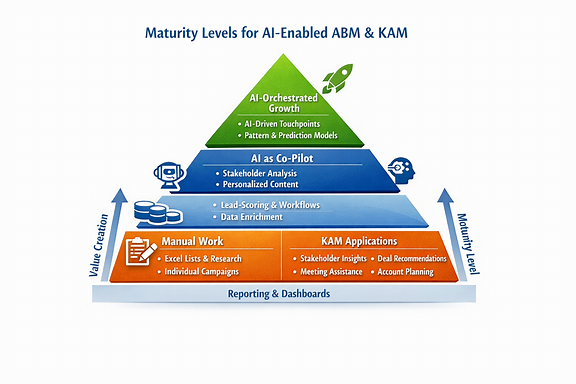
You can’t build the Growth Triangle (ABM + Account Management + AI Agents) in one big leap. You build it in stages, each one strengthening the next. The goal is a realistic, executable path — from early AI assistance to a fully orchestrated, agent‑driven revenue system.
Here’s the five‑stage maturity model.
Stage 1 — Establish the Foundations: Data, CRM, Roles
Goal: Structure, clarity, and operational hygiene.
This stage is not about AI — it’s about preparing the environment so AI can actually work.
You establish:
- a clean, structured CRM
- defined buying‑group models
- prioritized ABM target accounts
- clear Account Management roles and responsibilities
- tagged content (persona, funnel stage, industry)
Why it matters: Without clean data and clear roles, AI can’t produce meaningful output. This is the “do your homework” phase.
Stage 2 — AI as an Assistant: Insights, Research, Content
Goal: AI supports people — but doesn’t run processes.
This is where the first AI Agents come into play, but only as assistants:
- AI‑powered account, industry, and stakeholder research
- AI‑generated content variants and personalization
- AI‑generated meeting summaries
- AI‑interpreted intent signals
Value: Teams become faster, more precise, and less burdened by manual work. But AI is not yet autonomous or connected across functions.
Stage 3 — AI as a Co‑Pilot: Pattern Recognition & Recommendations
Goal: AI becomes a strategic partner.
This is where ABM and Account Management truly begin to integrate:
AI Agents:
- detect patterns across intent, CRM, and interaction data
- recommend stakeholder priorities
- suggest next best actions
- assess risks inside the buying group
- dynamically adapt content recommendations
Value: Marketing and Account Management operate on a shared, data‑driven decision foundation for the first time.
Stage 4 — AI as an Orchestrator: Touchpoints & Feedback Loops
Goal: AI connects Marketing, Sales, and Account Management operationally.
This is where the Growth Triangle becomes real:
AI Agents:
- orchestrate touchpoints across channels
- synchronize ABM campaigns with Account Management activities
- detect stakeholder activity in real time
- adjust campaigns automatically (tone, timing, content)
- close feedback loops between Marketing and Account Management
Value: The customer journey becomes dynamic, adaptive, and relationship‑intelligent.
Stage 5 — AI as a System: Multi‑Agent Orchestration
Goal: A scalable, learning revenue engine.
In the final stage, multiple specialized AI Agents work together:
- ABM Agent: intent radar, campaign steering
- Account Agent: stakeholder management, relationship intelligence
- Content Agent: personalization, variants, tone
- Research Agent: market and account insights
- Success Agent: adoption, expansion, churn risk
These agents:
- share data
- synchronize decisions
- learn from interactions
- continuously optimize the journey
Value: A scalable, learning system that automates relevance, timing, and relationship depth — without losing human judgment.
How Companies Move Between Stages
To keep the journey realistic, three principles matter:
- Human‑in‑the‑Loop (HITL)
Humans remain the decision‑makers. AI provides recommendations — not final actions.
- Modular Build‑Up
Each stage works on its own. No big‑bang transformation.
- Shared Ownership
Marketing + Sales + RevOps + IT + Account Management must co‑own the system. Otherwise AI becomes a siloed experiment.
The End State: An AI‑Enabled Revenue Operating System
Once all stages are in place, you get:
- a real‑time buying‑group radar
- an orchestrated ABM/Account Management process
- a learning system of AI Agents
- a scalable relationship strategy
- a revenue model that no longer depends on individual heroics
This is the point where AI doesn’t just improve efficiency — it drives growth.
- Trust, Compliance & Responsible AI
Whenever this model is discussed with European companies, one objection comes up almost immediately:
“We can’t do this — data privacy won’t allow it.”
In the US, the equivalent objection sounds like:
“This won’t work with our compliance requirements and risk controls.”
The good news: ABM + Account Management + AI Agents are fully compatible with modern privacy, security, and compliance standards — when built correctly.
The bad news: Many European companies copy US‑style ABM and AI models that don’t fit their own compliance frameworks or data governance maturity.
Here’s the realistic, compliance‑safe way to implement this model in a US context.
- Core Principle: Focus on Account‑Level Data, Not Personal Profiles
Modern ABM — especially in regulated industries — works at the account level, not the individual level.
This means:
- focus on companies, not individuals
- use firmographic and account‑level intent data
- avoid personal tracking without explicit consent
- model roles, not personal identities
AI Agents operate on:
- “CFO,” not “John Smith”
- “IT Director,” not “Sarah Johnson”
This keeps the system compliant with:
- internal data‑handling policies
- SOC2 requirements
- enterprise privacy frameworks
- industry‑specific regulations (HIPAA, FINRA, etc.)
The model stays clean, safe, and fully auditable.
- Where US Companies Get Compliant Intent Data
Intent data is absolutely available in the US — but it must be sourced responsibly.
Fully compliant sources
First‑party intent (always safe):
- website visits (anonymized or consent‑based)
- content downloads
- webinar and event engagement
- email interactions
- product usage data
- chat interactions
Contextual intent:
- industry research
- topic clusters
- search trends at the company level
US‑compliant third‑party intent providers:
- Bombora
- 6sense
- Demandbase
- ZoomInfo (account‑level intent)
- G2 Buyer Intent
These providers deliver account‑level signals, not personal profiles.
❌EU: Not compliant without explicit consent
- personal tracking across devices
- cookie‑based third‑party profiles
- identity‑level behavioral data
- inferred personal profiles
Conclusion: Intent data is absolutely possible — In EU it just needs to be account‑based and responsibly sourced.
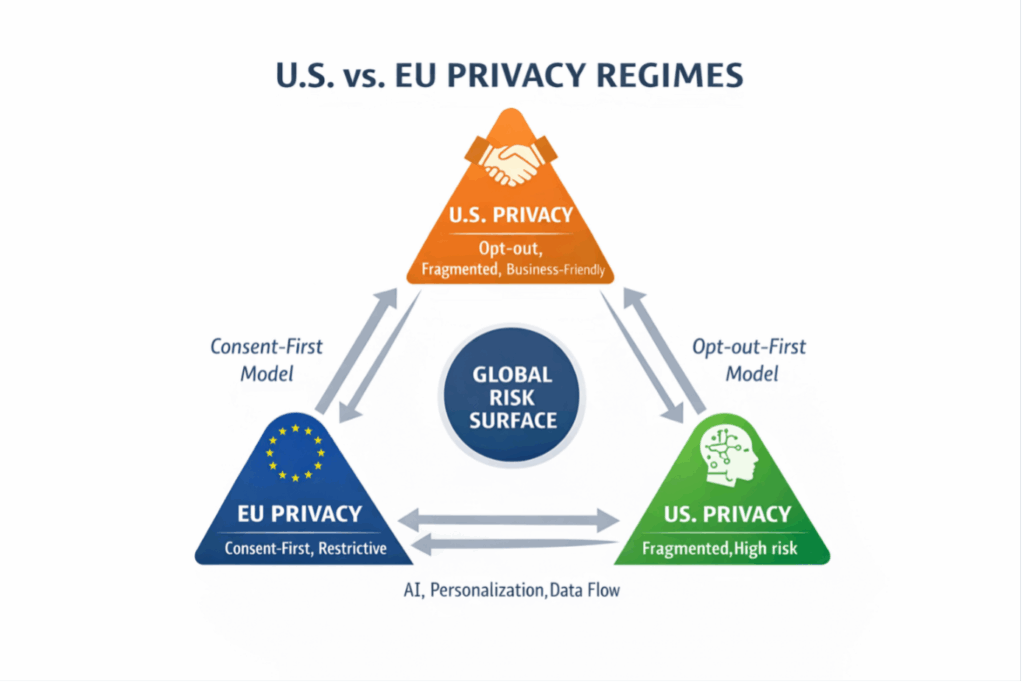
Modern privacy regulation splits into two fundamentally different models. Understanding this divide is essential for compliant growth, cross‑market expansion, and AI‑driven personalization.
European Union — Consent‑First, Restrictive, Unified
Core Principle: “No processing without a legal basis.”
Implications for your business:
- Explicit opt‑in required for tracking, cookies, profiling, and cross‑site identifiers
- Inferred profiles = personal data → requires a legal basis
- Strong, centralized enforcement with high penalties (up to 4% of global revenue)
- Standardized rights across all member states
- AI and automated decision‑making face strict transparency and consent requirements
CEO takeaway: EU privacy sets the global high‑water mark. If you meet GDPR, you meet most global expectations.
United States — Opt‑Out, Fragmented, Business‑Friendly
Core Principle: “Notify the user and let them opt out.”
Implications for your business:
- Tracking, profiling, and cross‑device identifiers allowed by default
- Opt‑out required for targeted advertising and data “sharing”
- Opt‑in only for sensitive data and minors
- No federal law — compliance varies by state (California, Colorado, Virginia, etc.)
- Enforcement is state‑driven and less punitive than GDPR
CEO takeaway: US privacy is lighter, but fragmentation increases operational complexity.
Strategic Comparison
Dimension
EU (GDPR)
US (State Laws)
Regulatory Model
Unified
Fragmented
Consent
Opt‑in
Opt‑out
Cookies & Tracking
Consent required
No consent; opt‑out for targeted ads
Profiling
Consent for most cases
Opt‑out unless sensitive
Sensitive Data
Opt‑in
Opt‑in
Enforcement
High, centralized
Moderate, state‑level
Risk Level
High
Medium
What CEOs Should Do Now
- Adopt GDPR as your global baseline
It reduces complexity and future‑proofs your data strategy.
- Implement unified consent & preference management
One system → all markets → lower compliance overhead.
- Classify your data
Especially inferred profiles, behavioral identifiers, and cross‑device signals.
- Build AI governance early
AI models amplify privacy risk if training data isn’t compliant.
- Prepare for US federal regulation
It’s not here yet — but it’s coming.
CEO Bottom Line
EU = strict, consent‑driven, high risk. US = flexible, opt‑out, operationally fragmented.
Winning companies design privacy as a global operating system, not a patchwork of local fixes.
- How AI Agents Operate in a Compliance‑Safe Way
AI Agents can do a lot — but they must operate within clear boundaries.
AI Agents may:
- analyze data the company already owns
- detect patterns without creating personal profiles
- use role‑based models (CFO, IT Director, etc.)
- recommend actions
- orchestrate touchpoints
- personalize content at the account level
AI Agents may NOT:
- process personal data without consent
- create shadow profiles
- send autonomous outbound communication
- make decisions without human oversight
Solution: A combination of:
- role‑based modeling
- account‑level data
- human‑in‑the‑loop controls
- transparent audit trails
This keeps the system safe, compliant, and enterprise‑ready.
- Governance: How to Make the Model Scalable and Safe
This is where many companies feel uncertain. The solution is a three‑layer governance model that embeds AI Agents safely into the GTM engine.
Governance Layer 1 — Data Governance
- clear data sources
- data classification (public, internal, sensitive)
- retention and deletion rules
- access controls
- audit trails
Goal: AI Agents know what data they can use — and what they can’t.
Governance Layer 2 — AI Governance
- defined agent roles
- approval workflows (HITL)
- logging of all agent actions
- risk scoring for sensitive tasks
- transparency of decision logic
Goal: AI Agents operate in a controlled, auditable, predictable way.
Governance Layer 3 — Communication Governance
- AI may draft, but not send
- tone and messaging reviewed by humans
- escalation rules for strategic accounts
- compliance review for templates
Goal: AI supports communication — humans own it.
What a Compliance‑Safe AI‑Enabled ABM/Account‑Management System Looks Like
Data Flow
- intent data → anonymized, account‑level
- CRM data → structured, role‑based
- content data → tagged, API‑accessible
AI Agents
- detect patterns
- prioritize accounts
- recommend touchpoints
- personalize content
- synchronize ABM & Account Management
Governance
- human approval
- audit trails
- role‑based access
- compliant data handling
Result: A modern, trust‑aligned revenue engine that uses AI responsibly — without violating privacy or compliance standards.
In Short: How to Do AI‑Enabled ABM in a US‑Compliant Way
- Account‑based, not identity‑based
- First‑party intent instead of personal tracking
- Role models instead of personal profiles
- Human‑in‑the‑loop instead of autonomous AI
- Governance instead of gray zones
This makes the Growth Triangle not only possible — but a competitive advantage, especially in industries where trust and compliance are buying criteria.
- The Organizational Foundations for an AI‑Enabled ABM & Account Management Model
One of the most common objections — especially in mid‑market companies — is:
“This sounds great in theory, but our organization isn’t set up for this.”
And that’s exactly where most companies hit the real bottleneck: the organizational readiness required to make ABM + Account Management + AI Agents actually work.
Technology alone won’t fix this. Without the right structure, roles, and processes, the model remains a pilot that never scales.
Here are the organizational foundations required to support the Growth Triangle.
- Structural Requirements
1.1 Shared Ownership Across Marketing, Sales, and Account Management
The model only works when these functions co‑own it — not when they operate in silos.
You need:
- a joint steering committee
- shared KPIs
- shared prioritization of target accounts
- shared definition of buying‑group roles
Why: AI Agents need clarity on who owns what. Without shared ownership, they amplify chaos instead of alignment.
1.2 An ABM/Account‑Management Operating Model
Many companies treat ABM as a campaign — not as an operating system.
Organizationally, you need:
- defined account tiers (Tier 1–3)
- clear rules for when ABM leads and when Account Management leads
- coordinated touchpoint orchestration
- unified data and documentation standards
Goal: A seamless process that AI Agents can support end‑to‑end.
1.3 An AI‑Ready Enablement Setup
Teams must be equipped to:
- use AI tools
- interpret AI recommendations
- validate AI outputs (HITL)
- document AI‑supported processes
Without enablement: AI becomes a toy for a few enthusiasts — not a scalable capability.
- Roles & Responsibilities
For AI Agents to work effectively, roles must be clearly defined.
2.1 ABM Lead / Growth Marketing
Responsible for:
- intent data
- campaigns
- content personalization
- signals for AI Agents
2.2 Account Management Lead / Account Owner
Responsible for:
- buying‑group mapping
- internal dynamics
- relationship building
- validating AI recommendations
2.3 RevOps / Sales Ops
Responsible for:
- data quality
- CRM structure
- integrations
- reporting
RevOps is the connective tissue that binds ABM, Account Management, and AI Agents.
2.4 AI Governance / Data Steward
Responsible for:
- compliance
- data classification
- approval workflows
- audit trails
Without this role, AI becomes a compliance risk.
- Processes & Governance
3.1 A Unified Account‑Planning Process
ABM + Account Management + AI Agents need:
- shared goals
- shared stakeholder analysis
- shared prioritization
- shared content strategy
AI Agents can accelerate this process — but they cannot replace it.
3.2 Human‑in‑the‑Loop (HITL) Checkpoints
To keep AI compliant and trustworthy:
- AI recommends
- humans decide
- AI documents
HITL checkpoints are mandatory for:
- communication
- stakeholder assessments
- risk analysis
- content personalization
3.3 Clear Rules for Data Usage
To ensure AI Agents operate safely:
- which data can be used
- which data is restricted
- which data is sensitive
- how long data may be stored
This is the core of governance.
3.4 Feedback Loops Between Marketing and Account Management
For the system to learn:
- Account Management provides meeting feedback
- Marketing adjusts campaigns
- AI Agents update models
- RevOps checks data quality
Without feedback loops, AI stays dumb.
The Organizational Big Picture
When all prerequisites are in place, you get:
- a shared vision
- a unified process
- clear roles
- clean data
- controlled AI Agents
- compliant governance
This is the organizational backbone that makes the Growth Triangle operational.
In Short: What the Organization Must Be Able to Do
- Collaborate — Marketing, Sales, Account Management, RevOps, IT
- Standardize — data, processes, roles, touchpoints
- Scale responsibly — AI Agents with governance, not chaos
- How Mid‑Market Companies Can Implement This Model Without Additional Headcount or Big Budgets
One of the most common objections — especially from mid‑market companies — is:
“We love the concept, but we don’t have the people or the budget to do this.”
Here’s the truth: Mid‑market companies can implement this model more easily than enterprises — if they approach it lean, modular, and pragmatic.
You don’t need new hires. You don’t need a massive tech stack. You don’t need a big‑bang transformation.
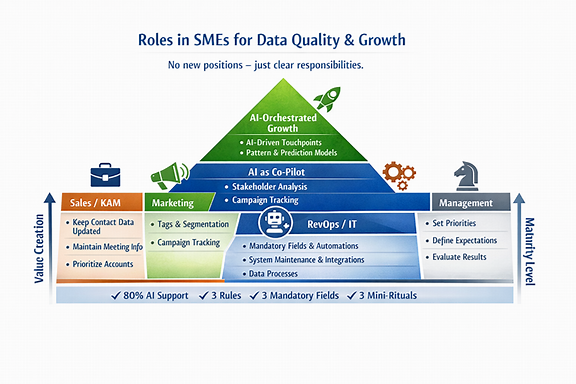
Here’s how mid market organizations can make the Growth Triangle work with the team they already have.
- Focus on What Matters: 20% Effort, 80% Impact
- not 100 target accounts → 10–20 strategic accounts
- not 10 campaigns → 1–2 high‑impact plays
- not 5 AI Agents → 1–2 that deliver real relief
- AI Doesn’t Replace People — It Replaces Manual Work
- research
- data preparation
- meeting summaries
- content variants
- stakeholder analysis
- intent interpretation
- touchpoint suggestions
- Combine Roles Instead of Creating New Ones
No new hires. Just clear responsibilities.Role Who Owns It (Realistically) ABM Lead Marketing (part‑time) Account Management Lead Sales / Account Owner RevOps Light Marketing + Sales jointly AI Governance IT or Data Privacy Officer (1–2 hours/month) - Small Tech Steps Instead of Big Platforms
- CRM: HubSpot or Microsoft Dynamics (often already in place)
- Marketing Automation: HubSpot or ActiveCampaign
- Intent Data: Dealfront, Echobot, Bombora (EU/US‑compliant, affordable)
- AI Agents: modular tools or built‑in AI features
- A Three‑Stage Plan That Works Without Additional Staff
- clean CRM
- define target accounts
- model buying groups
- tag content
- activate AI assistance for research & content
- AI‑generated meeting summaries
- AI‑supported stakeholder analysis
- AI‑driven content personalization
- AI‑interpreted intent signals
- AI suggests touchpoints
- AI synchronizes ABM + Account Management
- AI detects buying‑group patterns
- AI supports account planning
- Governance for Mid‑Market: Small, Clear, Practical
- AI may analyze, but not send communication
- AI may use account‑level data, not personal profiles
- AI outputs must be reviewed by humans
- Data privacy reviews once per quarter
- The Most Important Point: Mid‑Market Has a Built‑In Advantage
- silos
- politics
- legacy systems
- 12 stakeholders per decision
- short decision paths
- less complexity
- pragmatic teams
- faster execution
- Focus over volume
- AI as a capacity multiplier
- Role bundling instead of new roles
- Small tools instead of big platforms
- Clear rules instead of heavy governance
- Step‑by‑step maturity instead of big‑bang transformation
- The Final Objection: “Our Data Quality Is Too Poor, and No One Owns It.”
- You Don’t Need Perfect Data — You Need Structured Data
- perfect CRM hygiene
- complete buying‑group records
- flawless activity logs
- consistent fields
- predictable formats
- stable account hierarchies
- basic buying‑group roles
- Data Ownership Must Be Distributed — Not Centralized
- IT
- RevOps
- Sales Ops
- a “data team”
- Marketing owns marketing data
- Sales owns pipeline and activity data
- Account Management owns buying‑group data
- RevOps owns structure, standards, and governance
- AI Agents Reduce the Data‑Quality Burden
- detect missing fields
- flag inconsistent data
- summarize meeting notes into structured CRM entries
- extract buying‑group roles from conversations
- identify duplicates
- enrich accounts with public data
- recommend corrections
- A Simple, 3‑Layer Data‑Quality Framework That Actually Works
- required fields
- naming conventions
- buying‑group roles
- pipeline stages
- account hierarchy rules
- Marketing → intent, engagement, campaign data
- Sales → pipeline, activities, opportunity data
- Account Management → buying‑group, relationship, meeting insights
- validate
- enrich
- structure
- summarize
- flag issues
- The Most Important Mindset Shift: Data Quality Is a By‑Product of Good Process
- clearer processes
- fewer exceptions
- simpler rules
- better automation
- shared ownership
- What “Good Enough” Data Looks Like for AI‑Enabled ABM
- correct account names
- basic buying‑group roles
- consistent opportunity stages
- tagged content
- intent signals connected to accounts
- meeting notes captured (AI can structure them)
- orchestrate touchpoints
- detect patterns
- recommend actions
- surface risks
- support account planning
- The Real Risk Is Not Bad Data — It’s No Ownership
- shared KPIs
- shared processes
- shared definitions
- shared accountability
- You don’t need perfect data — just structured data
- Ownership must be distributed, not centralized
- AI Agents reduce the data‑quality burden
- RevOps sets standards, not does cleanup
- Data quality emerges from process, not heroics
- “Good enough” is enough to start
- The real blocker is unclear ownership, not messy data
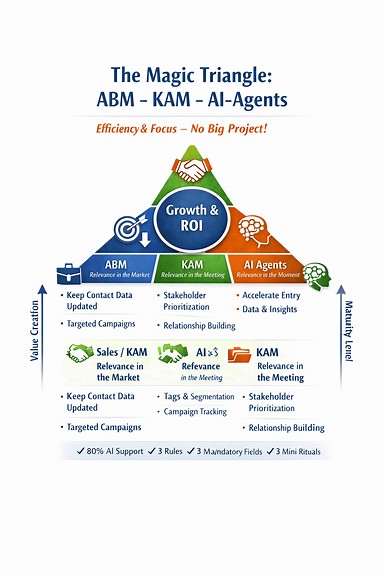
If you want to know more about the use of AI-Agents in Markting and Sales go to